家計簿 · Kakeibo · the Japanese household ledger

Spend with intention.
Save with calm.

Zaimu turns kakeibo — the Japanese household ledger from 1904 — into a private app. Set your savings aside first, split the rest across four pillars and close every month with a reflection. No accounts, no cloud, no subscription.

  • 無 No accounts, no sign-up
  • 端 Your data stays on your phone
  • 銀 No bank connection
  • 一 One-time payment, no subscription

一 · The method

One ledger, four questions

Kakeibo (家計簿, “household ledger”) automates nothing. It asks you to stop once a month and answer four questions honestly. That pause is what changes your relationship with money.

In 1904 Hani Motoko, regarded as Japan’s first woman journalist, published it in the women’s magazine she founded with her husband. More than a century later it still works because it depends on no technology — only on looking at your money honestly.

貯Savings come off the top.
What is left is what you can spend.

Read the complete kakeibo guide →

家計簿October
一

How much money do I have?

Your real income this month, not rounded in your favour.

二

How much do I want to save?

Decided before you spend. It is not what is left over — it comes first.

三

How much am I spending?

Every expense in its pillar: survival, wants, culture or unexpected.

四

How can I improve?

The end-of-month reflection: what worked, what did not, what you change.

二 · Try it

Your kakeibo month in 30 seconds

Enter what you earn and what you want to save. You will see how much you can spend and how it splits across the four pillars.

Everything is calculated in your browser. Nothing is stored or sent.

You can spend—
Saved first—
Survival
—
Wants
—
Culture
—
Unexpected
—

Adjust the split, see your weekly limit and print your sheet →

三 · The app

Three rituals for spending with intention

Zaimu does not take control away. It gives back the pause other apps remove.

The 72-hour filter

Fancy something? Put it in the basket. After 72 hours, if you still want it, go ahead. What you do not buy adds up in your “saved by waiting” total.

End-of-month reflection

Four guided questions to close the month: did I hit my savings goal? which pillar got away from me? what did I learn? It is not accounting — it is a conversation with yourself.

Only yours

Your data lives on your phone. No account, no server, no bank. Export to CSV or keep a backup in your own cloud whenever you decide.

Coming next

  • Import your bank statement without connecting your bank, classified on your phone.
  • Widgets and shortcuts to log an expense in two seconds.
  • A shared month with your partner, end-to-end encrypted.
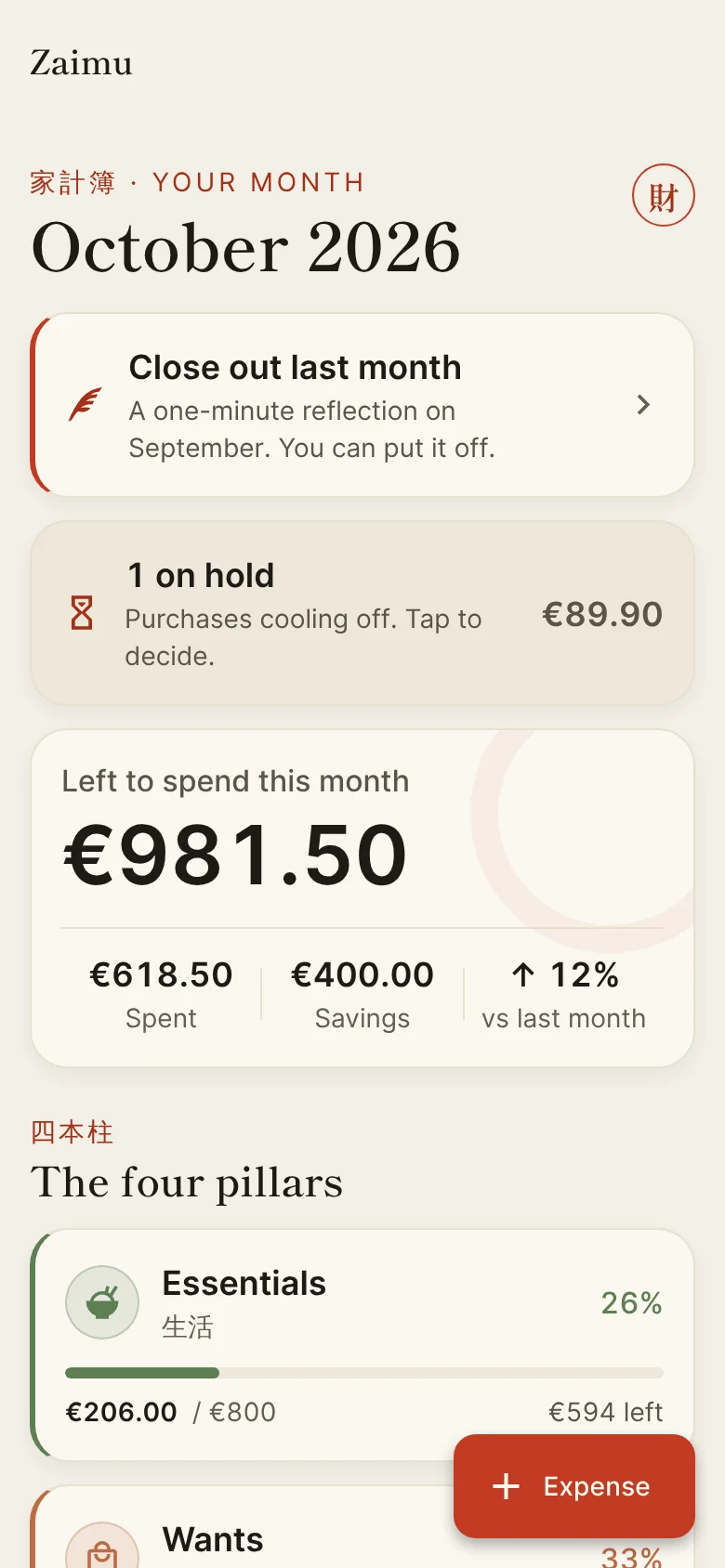
Zaimu home screen: £1,474.80 left this month and the four pillars with their progress

Screenshot of the Zaimu web app with sample data.

四 · The story

One woman, one notebook, over a hundred years

At a time when many Japanese women could not own property, Hani Motoko argued that running the household’s money with care was a practical and moral act that deserved the same intellectual respect as any other discipline. Her 家計簿 did not ask you to save more. It asked you to look more closely.

Today, when almost all money moves with one tap, that old gesture makes sense again. Zaimu brings it to your phone without giving up what matters: the pause, the intention and your privacy.

Friction is not an obstacle. It is the space where your decision lives.

Every month you close stamps its seal. Twelve seals, one year at a glance.

五 · The difference

Two ways of looking at your money

Bank-connected apps

  • They ask for access to your bank.
  • Your transactions live on the company’s servers.
  • They categorise for you: you see the report after the spending happened.
  • A monthly or yearly subscription to keep using them.

Zaimu

  • No bank, no email, no account needed to use it.
  • Your data lives on your phone and you export it whenever you like.
  • You decide before you spend: pillars, a 72-hour filter, a monthly reflection.
  • One-time payment. What you buy is yours.

An honest comparison of the best kakeibo apps in 2026 →

六 · Questions

Frequently asked questions

What is kakeibo (kakebo)?

It is the Japanese saving method created in 1904 by Hani Motoko. You set your savings aside first, split the rest across four pillars (survival, wants, culture and unexpected) and close each month with a reflection. “Kakebo” is the usual Spanish spelling; “kakeibo” is the Japanese romanisation.

Do I need to connect my bank?

No. Zaimu never connects to a bank or asks for credentials. You log your own expenses, which is exactly what makes the method work. You can import the CSV or OFX you download from your bank (Advanced plan): it is read on your device, with no bank connection.

Where is my data stored?

On your device (in the web version, inside your browser). There are no accounts and no servers holding your financial data in the clear. If you want a backup, you keep it in your own storage. Only if you subscribe to Pro and turn on sync is an encrypted copy uploaded, encrypted on your device so not even we can read it.

How much will Zaimu cost?

You can start free, no card needed. Unlocking the full kakeibo is a one-time payment, no subscription; the optional Pro extras are a subscription you can cancel without losing what you bought.

Which phones will it run on?

Today it runs in your phone or computer browser and you can install it on your home screen. iPhone and Android store apps will follow.

Does it work offline?

Yes. After your first visit Zaimu works offline.

Can I take my data out?

Yes. You can export your expenses to CSV and create a full backup whenever you like.

Which languages does it support?

Spanish and English.

Your month starts with a question

Start free in your browser. If you would rather wait for the iPhone and Android apps, leave your email and we will write once.